Dubai and the Maldives in one honeymoon: how to combine them
Dubai and the Maldives are four hours apart and share one winter season. How to combine city and island in one honeymoon — and when to choose just one.
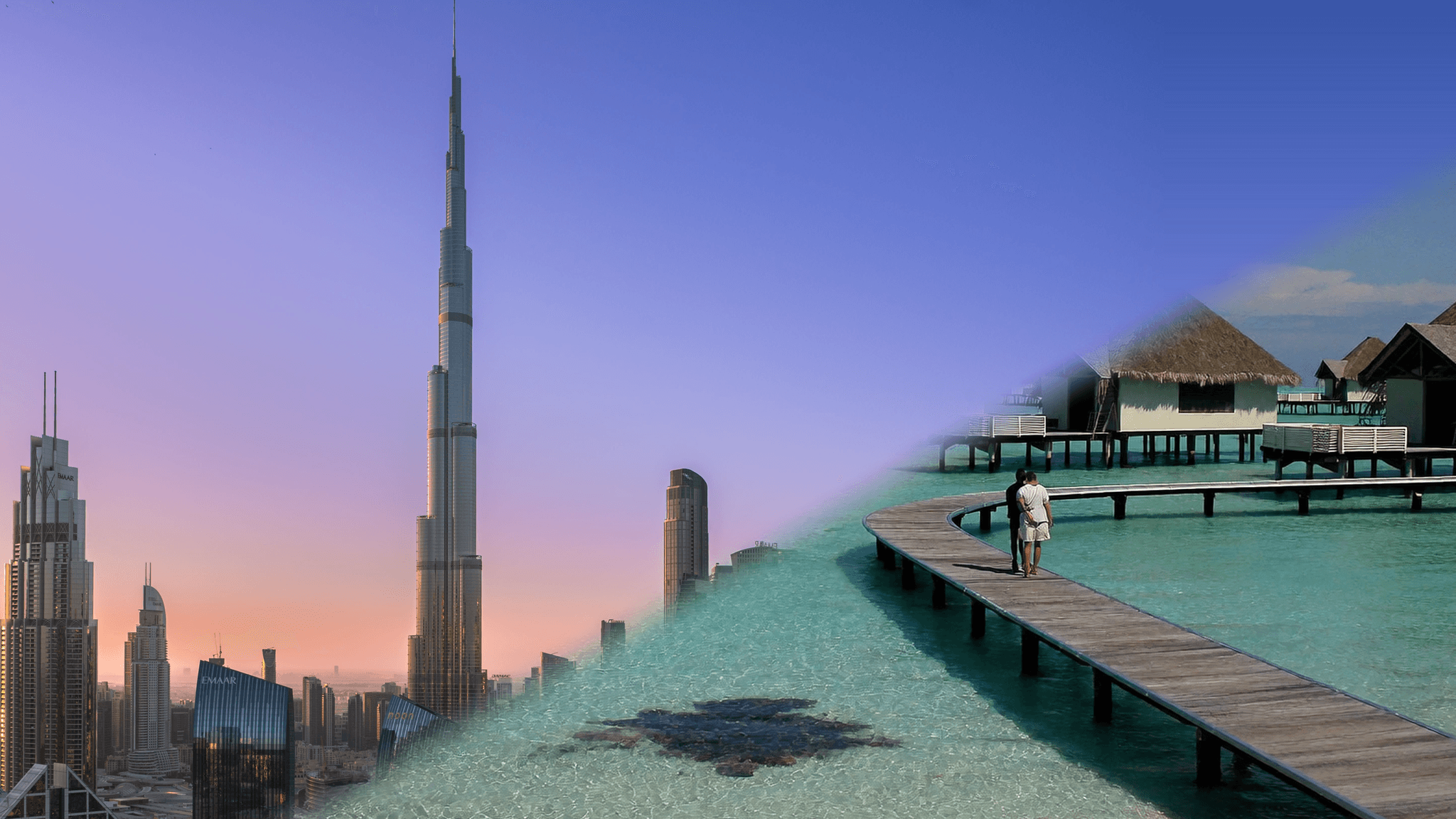
The short answer: yes, Dubai and the Maldives combine well in one honeymoon. Nonstop flights link them in around four hours, they share the same winter season, and we generally build the trip in one direction — Dubai first, then the island: a few nights of city and spectacle, then a week of water and silence. If you only have time for one, choose Dubai if the two of you relax by doing things, and the Maldives if you relax by stopping.
This is the route we walk couples through at AVEC TOI Collection when winter plans become real — in the same honest spirit as our Maldives or Bora Bora and Mauritius or Seychelles comparisons. What follows is how the combination works, when the season decides for you, what each half of the trip actually feels like, and the cases where we would tell you not to book with us at all.
The wrong question: Dubai or the Maldives
Asked as either-or, the question throws away its best answer. Dubai and the Maldives are not two versions of the same holiday to be ranked against each other. They are opposites — a city that runs on decisions and an island that runs on none — which happen to sit four hours apart in the same season. Opposites four hours apart are not a choice. They are a sequence.
The real question is what you want a day to contain, and in what order. In Dubai, a day contains decisions: which restaurant, which side of the city, the desert or the boat. On a Maldivian island, a day contains almost none, and that is the entire design. If you want both kinds of day, the route below gives you both. If you only want one, the second half of this article helps you choose.
How to combine Dubai and the Maldives: the route
Dubai works naturally as a stopover on the way east, and as of September 2026 nonstop flights link Dubai and Malé in around four hours — close enough that combining the two is a route, not an expedition. From Central Europe you fly into Dubai, spend your first nights there, and continue to the Maldives on a flight short enough that the transfer day is not a lost day. After Malé, a seaplane or speedboat takes you to your island.
We generally build it in one direction: Dubai first, while your energy is high, then the island — so that the quietest days come last and the trip lands softly instead of ending in traffic. In practice that means a few nights of city and spectacle — a suite high above the skyline or a villa on the beach, a yacht as the sun goes down, a night in a private desert camp — and then a week of water and silence: an overwater villa with its own pool, the house reef, a candlelit dinner on a sandbank. The two halves make each other better. The desert makes the lagoon quieter, and the lagoon forgives the city everything.
We build the reverse order — island first, city to finish — only when flight times or a wedding date make it the natural way round. It works, but the trip ends loud instead of quiet, and we say so before we plan it that way.
Across ten to twelve days, this is the version we generally recommend to couples who cannot agree — one of you restless, one of you longing for stillness. It is not a compromise between your two answers. It is the answer.
Best time to visit Dubai and the Maldives: November to March, November to April
The window we plan around is November to March for Dubai and November to April for the Maldives. The two overlap almost completely, which is what makes the combination a natural winter honeymoon: both halves are in season at once, and neither asks you to gamble on the weather in those months.
If you are reading this in autumn, you are not late. The winter window opens in November for both, and a wedding in October or November points naturally at either — or at both.
How many days do Dubai and the Maldives each need?
Dubai is the flexible one. We generally plan it either as a two-to-three-night stopover on the way east or as a four-to-five-night holiday in its own right — it is the one trip in this pairing that rewards even a short window. Because there is no onward transfer after landing, the first evening already belongs to you.
The Maldives ask for more commitment. The travel alone — a long-haul flight, then a seaplane or speedboat — argues against a short stay, and the island's slow rhythm is the point of the trip rather than its backdrop. We generally advise a full week on one island. We rarely advise much more than that on a single island, unless doing absolutely nothing is the explicit plan — and for the couples who mean it, it is a wonderful plan.
For the combination, we generally build across ten to twelve days: a few nights of city, then a week of water. Less than that, and one half of the trip is rushed; we would rather you chose one.
Dubai in winter: a city honeymoon with a beach attached
From Central Europe, Dubai is the nearest of the classic long-haul winter escapes. That proximity changes the character of the trip: it is the one destination in this pairing that does not ask for a large block of time, and the one that works even when the calendar is tight.
What makes Dubai interesting for couples is not the skyline itself but the contrast it allows. The city runs between spectacle and stillness: a suite high above the city or a villa on the beach, a yacht as the sun goes down, and then — out beyond the city — a private desert camp where the loudest thing is the fire. Evenings are the city's strong suit. Tables get reserved, the skyline turns on, and every night can be different from the last.
The days have structure, and for some couples that structure is exactly the point. Breakfast, beach, an afternoon plan, a booked table. If one of you tends to get restless on the third day of every beach holiday, Dubai absorbs that restlessness better than any island can.
What Dubai is not: remote. It is a functioning city, and it feels like one. The privacy you get is the privacy of a good suite, a reserved table and an empty desert at night — arranged, not automatic.
The Maldives in winter: one island, one villa, almost no decisions
The Maldives are the opposite proposition. Flat coral atolls, shallow and exceptionally clear lagoons, and a quiet you do not find in many places on earth. The journey from Europe is a long-haul flight, often overnight and direct, then a seaplane or speedboat to the island. Leave in the evening, and you are on your deck by the following midday — or, on the combined route, arrive from Dubai in the early afternoon and let the seaplane do the rest.
One island, one resort, one week — that is the shape of the trip. The island you choose is the entire holiday: your villa, your stretch of lagoon, the house reef. The moments that define it are small and unhurried. Breakfast floating in your own pool. A candlelit dinner on a sandbank. Mantas passing the reef at dusk. A spa suspended above the water. If the villa itself is the decision you are weighing, we have written separately about overwater villas versus private islands.
The honesty this article owes you: anyone who wants to move around is limited there. Every time you leave the island, it involves a boat. There is no walking out to find a different restaurant, no neighbourhood to discover, no plan B for the evening. Couples who want to stop moving experience that as the whole point. Couples who relax by exploring experience it as a beautiful room they cannot leave — which is precisely why the city comes first on the combined route.
November to April is the most reliable window — which is why the Maldives own the northern winter, and why this pairing exists at all.
Dubai vs the Maldives: the differences that matter
Getting there. Dubai is the shorter trip door to door: no onward leg after you land. The Maldives add a seaplane or speedboat leg after the long-haul flight — part of the arrival ritual for some couples, a logistics tax for others.
The rhythm. In Dubai you will make more decisions in a day than in a Maldives week. That sentence decides the order of the route — and, for couples who can only take one, decides the choice.
The evenings. Dubai's evenings are its argument: a city of tables, terraces and skyline. On a Maldivian island, the evening is your villa, the water and, on the right night, a sandbank with a single table on it. One is theatre, the other is silence.
Privacy. The Maldives make privacy the default — a villa over your own water, an island that outsiders cannot casually reach. In Dubai, privacy is something we arrange: the suite, the desert camp, the boat. Both work; they are different kinds of alone.
When you do not need us for Dubai
In our experience, Dubai is the easiest half of this route to arrange on your own: the large houses sell their rooms directly, transfers are straightforward, and nothing about the city resists independent planning. If your Dubai is one well-chosen hotel, a beach and a handful of dinners, you can book that yourself in an evening — and you should.
Where AVEC TOI Collection earns its place is at the edges: the suite category that is actually worth the difference, the desert camp that is genuinely private rather than shared with a tour group, the boat, the table that is not available when you call. If none of that is part of your picture, book directly and spend the difference on the trip. We have written honestly about when a travel concierge is worth it — and when it is not; the same logic applies here.
The Maldives — and the combination — are a different case. Not because booking a resort is hard, but because the resort is the entire holiday, and because a two-destination route has moving parts: the flight that fits the seaplane schedule, the island that fits your landing time instead of leaving you waiting, the difference between two villa categories with the same name, the side of the island your deck faces. On a one-hotel island there is no correcting a wrong choice on arrival. This is what we check before recommending an island, and it is the kind of thing you cannot see from the outside.
If you can only choose one: Dubai if… the Maldives if…
Not every calendar allows twelve days. If it has to be one, this is how we would decide with you.
Choose Dubai if:
you relax by doing, and an empty week sounds like a threat
your window is shorter — with no onward transfer, Dubai fits fewer days
restaurants and a different evening every night matter to you
one of you loves the beach and the other is bored by day two — the city absorbs both
you want winter sun with the option of spectacle: desert, skyline, a yacht at sunset
Choose the Maldives if:
the entire point of this trip is to be left alone together
the water itself is the destination: the lagoon, the house reef, mantas at dusk
the overwater villa is the picture both of you already have in mind
you are happy to commit to one island and let the week slow down
you would rather have no plans than good ones
If neither feels right: other winter honeymoon options
The same November-to-March window opens more than these two doors. Thailand's Andaman coast — Phuket and the bays of Phang Nga — is in season then, and offers a middle path between city and island: a private pool villa with staff, a longtail boat through the bays of Phang Nga, dinner on the sand, and life beyond the resort whenever you want it. And for couples who feel they have seen all of this already, the Red Sea island resorts and the deserts of AlUla in Saudi Arabia share the same season — a different kind of answer entirely.
Winter is not short of answers. The question is only which silence — or which noise — the two of you are actually after.
The quiet next step
If you already know which of the two you are — or that you are both — the rest is detail: the right island, the right suite, the right order of days. Tell us where you are leaning, roughly when, and how long you have, and we will come back with a complete proposal. Begin your journey here — the proposal is free, and there is no obligation.
Frequently asked
Can you combine Dubai and the Maldives in one honeymoon?
Yes — it is a classic winter combination. As of September 2026, nonstop flights link Dubai and Malé in around four hours, and both destinations are in season from November onwards. We generally plan ten to twelve days: a few nights in Dubai, then a week on one island.
How long is the flight from Dubai to the Maldives?
Around four hours nonstop between Dubai and Malé, as of September 2026. From Malé, a seaplane or speedboat takes you on to your island.
Dubai first or the Maldives first?
We generally plan Dubai first and the island second, so the quietest days come last and the trip ends in silence rather than in a city. The reverse works when flight times or your wedding date make it the natural order — but expect the trip to end loud.
Is Dubai or the Maldives better for a honeymoon?
Neither is better; they are opposites sharing a season. Dubai is a city honeymoon with restaurants, skyline and desert. The Maldives are one island and near-total stillness. Couples who want their days full choose Dubai; couples who want them empty choose the Maldives; couples who want both combine them.
What is the best time to visit Dubai and the Maldives?
November to March for Dubai, and November to April for the Maldives. The two windows overlap almost completely, which is why the combination works as a winter honeymoon.
How long should you stay in the Maldives?
One island, one resort, one week — that is the shape of the trip. Couples who want more variety are better served adding Dubai at the start than adding a second island: every move between islands means another boat or seaplane transfer.
Is the Maldives too quiet for some couples?
Honestly, yes. An island you cannot leave without a boat rewards couples who want to stop moving, and tests couples who do not. If one of you relaxes by exploring, put Dubai first — or choose Dubai alone.
The short answer: yes, Dubai and the Maldives combine well in one honeymoon. Nonstop flights link them in around four hours, they share the same winter season, and we generally build the trip in one direction — Dubai first, then the island: a few nights of city and spectacle, then a week of water and silence. If you only have time for one, choose Dubai if the two of you relax by doing things, and the Maldives if you relax by stopping.
This is the route we walk couples through at AVEC TOI Collection when winter plans become real — in the same honest spirit as our Maldives or Bora Bora and Mauritius or Seychelles comparisons. What follows is how the combination works, when the season decides for you, what each half of the trip actually feels like, and the cases where we would tell you not to book with us at all.
The wrong question: Dubai or the Maldives
Asked as either-or, the question throws away its best answer. Dubai and the Maldives are not two versions of the same holiday to be ranked against each other. They are opposites — a city that runs on decisions and an island that runs on none — which happen to sit four hours apart in the same season. Opposites four hours apart are not a choice. They are a sequence.
The real question is what you want a day to contain, and in what order. In Dubai, a day contains decisions: which restaurant, which side of the city, the desert or the boat. On a Maldivian island, a day contains almost none, and that is the entire design. If you want both kinds of day, the route below gives you both. If you only want one, the second half of this article helps you choose.
How to combine Dubai and the Maldives: the route
Dubai works naturally as a stopover on the way east, and as of September 2026 nonstop flights link Dubai and Malé in around four hours — close enough that combining the two is a route, not an expedition. From Central Europe you fly into Dubai, spend your first nights there, and continue to the Maldives on a flight short enough that the transfer day is not a lost day. After Malé, a seaplane or speedboat takes you to your island.
We generally build it in one direction: Dubai first, while your energy is high, then the island — so that the quietest days come last and the trip lands softly instead of ending in traffic. In practice that means a few nights of city and spectacle — a suite high above the skyline or a villa on the beach, a yacht as the sun goes down, a night in a private desert camp — and then a week of water and silence: an overwater villa with its own pool, the house reef, a candlelit dinner on a sandbank. The two halves make each other better. The desert makes the lagoon quieter, and the lagoon forgives the city everything.
We build the reverse order — island first, city to finish — only when flight times or a wedding date make it the natural way round. It works, but the trip ends loud instead of quiet, and we say so before we plan it that way.
Across ten to twelve days, this is the version we generally recommend to couples who cannot agree — one of you restless, one of you longing for stillness. It is not a compromise between your two answers. It is the answer.
Best time to visit Dubai and the Maldives: November to March, November to April
The window we plan around is November to March for Dubai and November to April for the Maldives. The two overlap almost completely, which is what makes the combination a natural winter honeymoon: both halves are in season at once, and neither asks you to gamble on the weather in those months.
If you are reading this in autumn, you are not late. The winter window opens in November for both, and a wedding in October or November points naturally at either — or at both.
How many days do Dubai and the Maldives each need?
Dubai is the flexible one. We generally plan it either as a two-to-three-night stopover on the way east or as a four-to-five-night holiday in its own right — it is the one trip in this pairing that rewards even a short window. Because there is no onward transfer after landing, the first evening already belongs to you.
The Maldives ask for more commitment. The travel alone — a long-haul flight, then a seaplane or speedboat — argues against a short stay, and the island's slow rhythm is the point of the trip rather than its backdrop. We generally advise a full week on one island. We rarely advise much more than that on a single island, unless doing absolutely nothing is the explicit plan — and for the couples who mean it, it is a wonderful plan.
For the combination, we generally build across ten to twelve days: a few nights of city, then a week of water. Less than that, and one half of the trip is rushed; we would rather you chose one.
Dubai in winter: a city honeymoon with a beach attached
From Central Europe, Dubai is the nearest of the classic long-haul winter escapes. That proximity changes the character of the trip: it is the one destination in this pairing that does not ask for a large block of time, and the one that works even when the calendar is tight.
What makes Dubai interesting for couples is not the skyline itself but the contrast it allows. The city runs between spectacle and stillness: a suite high above the city or a villa on the beach, a yacht as the sun goes down, and then — out beyond the city — a private desert camp where the loudest thing is the fire. Evenings are the city's strong suit. Tables get reserved, the skyline turns on, and every night can be different from the last.
The days have structure, and for some couples that structure is exactly the point. Breakfast, beach, an afternoon plan, a booked table. If one of you tends to get restless on the third day of every beach holiday, Dubai absorbs that restlessness better than any island can.
What Dubai is not: remote. It is a functioning city, and it feels like one. The privacy you get is the privacy of a good suite, a reserved table and an empty desert at night — arranged, not automatic.
The Maldives in winter: one island, one villa, almost no decisions
The Maldives are the opposite proposition. Flat coral atolls, shallow and exceptionally clear lagoons, and a quiet you do not find in many places on earth. The journey from Europe is a long-haul flight, often overnight and direct, then a seaplane or speedboat to the island. Leave in the evening, and you are on your deck by the following midday — or, on the combined route, arrive from Dubai in the early afternoon and let the seaplane do the rest.
One island, one resort, one week — that is the shape of the trip. The island you choose is the entire holiday: your villa, your stretch of lagoon, the house reef. The moments that define it are small and unhurried. Breakfast floating in your own pool. A candlelit dinner on a sandbank. Mantas passing the reef at dusk. A spa suspended above the water. If the villa itself is the decision you are weighing, we have written separately about overwater villas versus private islands.
The honesty this article owes you: anyone who wants to move around is limited there. Every time you leave the island, it involves a boat. There is no walking out to find a different restaurant, no neighbourhood to discover, no plan B for the evening. Couples who want to stop moving experience that as the whole point. Couples who relax by exploring experience it as a beautiful room they cannot leave — which is precisely why the city comes first on the combined route.
November to April is the most reliable window — which is why the Maldives own the northern winter, and why this pairing exists at all.
Dubai vs the Maldives: the differences that matter
Getting there. Dubai is the shorter trip door to door: no onward leg after you land. The Maldives add a seaplane or speedboat leg after the long-haul flight — part of the arrival ritual for some couples, a logistics tax for others.
The rhythm. In Dubai you will make more decisions in a day than in a Maldives week. That sentence decides the order of the route — and, for couples who can only take one, decides the choice.
The evenings. Dubai's evenings are its argument: a city of tables, terraces and skyline. On a Maldivian island, the evening is your villa, the water and, on the right night, a sandbank with a single table on it. One is theatre, the other is silence.
Privacy. The Maldives make privacy the default — a villa over your own water, an island that outsiders cannot casually reach. In Dubai, privacy is something we arrange: the suite, the desert camp, the boat. Both work; they are different kinds of alone.
When you do not need us for Dubai
In our experience, Dubai is the easiest half of this route to arrange on your own: the large houses sell their rooms directly, transfers are straightforward, and nothing about the city resists independent planning. If your Dubai is one well-chosen hotel, a beach and a handful of dinners, you can book that yourself in an evening — and you should.
Where AVEC TOI Collection earns its place is at the edges: the suite category that is actually worth the difference, the desert camp that is genuinely private rather than shared with a tour group, the boat, the table that is not available when you call. If none of that is part of your picture, book directly and spend the difference on the trip. We have written honestly about when a travel concierge is worth it — and when it is not; the same logic applies here.
The Maldives — and the combination — are a different case. Not because booking a resort is hard, but because the resort is the entire holiday, and because a two-destination route has moving parts: the flight that fits the seaplane schedule, the island that fits your landing time instead of leaving you waiting, the difference between two villa categories with the same name, the side of the island your deck faces. On a one-hotel island there is no correcting a wrong choice on arrival. This is what we check before recommending an island, and it is the kind of thing you cannot see from the outside.
If you can only choose one: Dubai if… the Maldives if…
Not every calendar allows twelve days. If it has to be one, this is how we would decide with you.
Choose Dubai if:
you relax by doing, and an empty week sounds like a threat
your window is shorter — with no onward transfer, Dubai fits fewer days
restaurants and a different evening every night matter to you
one of you loves the beach and the other is bored by day two — the city absorbs both
you want winter sun with the option of spectacle: desert, skyline, a yacht at sunset
Choose the Maldives if:
the entire point of this trip is to be left alone together
the water itself is the destination: the lagoon, the house reef, mantas at dusk
the overwater villa is the picture both of you already have in mind
you are happy to commit to one island and let the week slow down
you would rather have no plans than good ones
If neither feels right: other winter honeymoon options
The same November-to-March window opens more than these two doors. Thailand's Andaman coast — Phuket and the bays of Phang Nga — is in season then, and offers a middle path between city and island: a private pool villa with staff, a longtail boat through the bays of Phang Nga, dinner on the sand, and life beyond the resort whenever you want it. And for couples who feel they have seen all of this already, the Red Sea island resorts and the deserts of AlUla in Saudi Arabia share the same season — a different kind of answer entirely.
Winter is not short of answers. The question is only which silence — or which noise — the two of you are actually after.
The quiet next step
If you already know which of the two you are — or that you are both — the rest is detail: the right island, the right suite, the right order of days. Tell us where you are leaning, roughly when, and how long you have, and we will come back with a complete proposal. Begin your journey here — the proposal is free, and there is no obligation.
Frequently asked
Can you combine Dubai and the Maldives in one honeymoon?
Yes — it is a classic winter combination. As of September 2026, nonstop flights link Dubai and Malé in around four hours, and both destinations are in season from November onwards. We generally plan ten to twelve days: a few nights in Dubai, then a week on one island.
How long is the flight from Dubai to the Maldives?
Around four hours nonstop between Dubai and Malé, as of September 2026. From Malé, a seaplane or speedboat takes you on to your island.
Dubai first or the Maldives first?
We generally plan Dubai first and the island second, so the quietest days come last and the trip ends in silence rather than in a city. The reverse works when flight times or your wedding date make it the natural order — but expect the trip to end loud.
Is Dubai or the Maldives better for a honeymoon?
Neither is better; they are opposites sharing a season. Dubai is a city honeymoon with restaurants, skyline and desert. The Maldives are one island and near-total stillness. Couples who want their days full choose Dubai; couples who want them empty choose the Maldives; couples who want both combine them.
What is the best time to visit Dubai and the Maldives?
November to March for Dubai, and November to April for the Maldives. The two windows overlap almost completely, which is why the combination works as a winter honeymoon.
How long should you stay in the Maldives?
One island, one resort, one week — that is the shape of the trip. Couples who want more variety are better served adding Dubai at the start than adding a second island: every move between islands means another boat or seaplane transfer.
Is the Maldives too quiet for some couples?
Honestly, yes. An island you cannot leave without a boat rewards couples who want to stop moving, and tests couples who do not. If one of you relaxes by exploring, put Dubai first — or choose Dubai alone.
Continue reading
Continue reading
More notes on destinations, timing and the decisions that quietly shape a journey.
More notes on destinations, timing and the decisions that quietly shape a journey.

